

My neighbor Dot came over in tears last spring, holding a bottle of retinol her dermatologist had recommended for the fine lines around her mouth. She'd used it exactly twice and her cheeks were flaking like old paint, red at the jawline and tight across the nose. Dot has rosacea-prone skin, the kind that turns pink if you look at it wrong, and that little glass bottle had turned her face into a war zone in 48 hours. She's not alone. I hear some version of this story from women in my own kitchen every few weeks, skin that reacts to nearly everything, a new cleanser, a scented lotion, a change in weather, but a face that still wants that smooth, dewy glow you remember from decades ago.
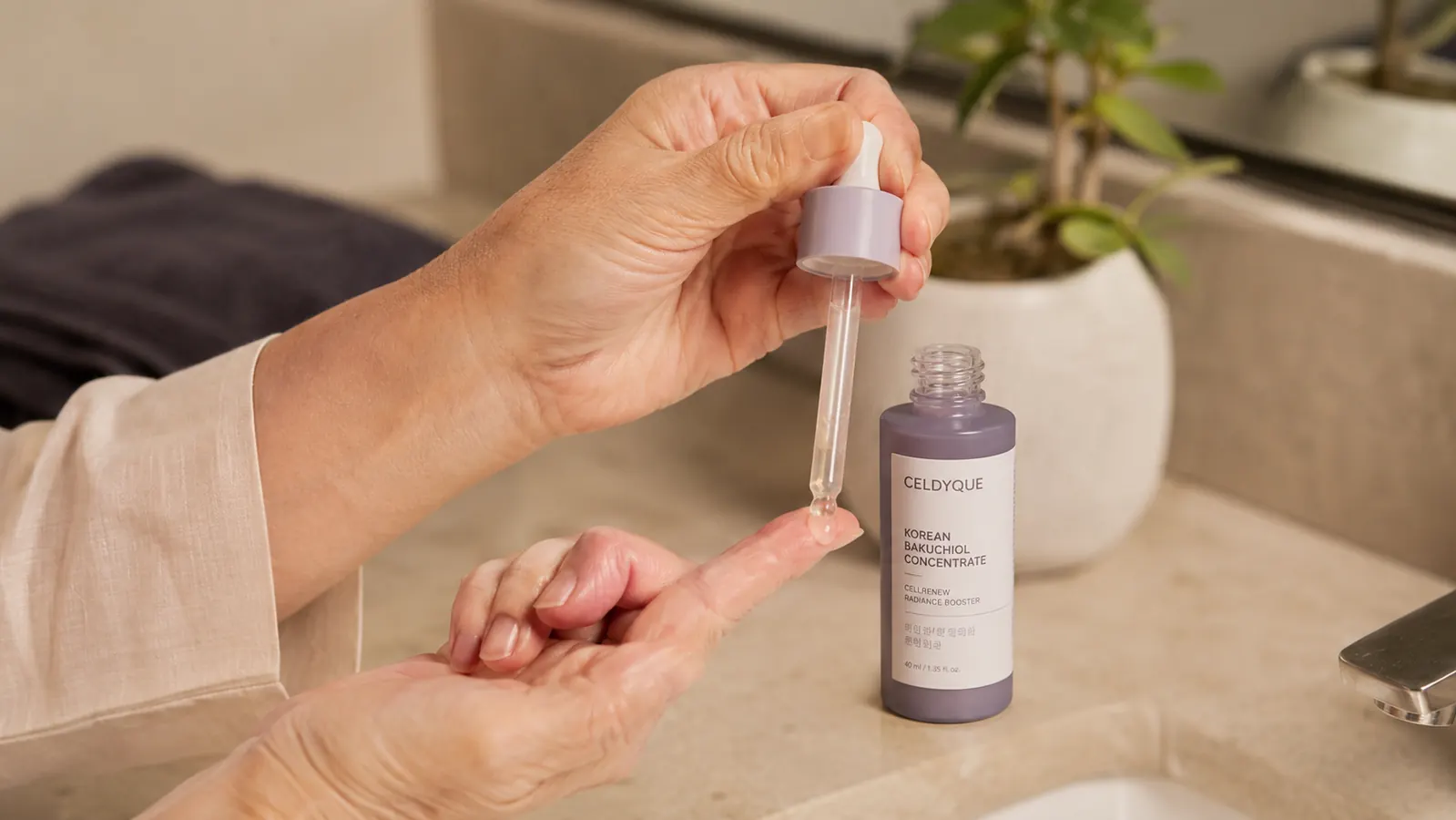
Here's the good news I gave Dot, and I'll give it to you too. There's a gentler path to the same glow, and it starts with bakuchiol serum, specifically the CELDYQUE Bakuchiol Concentrate Serum I've been testing on my own easily-irritated skin for the past several months. It's a plant-derived ingredient that works on some of the same skin pathways as retinol without retinol's scorched-earth side effects, and this particular formula, a high-potency 30,000 ppm concentrate, has become the one bottle I actually trust to hand to a sensitive-skin friend without a warning label attached. Follow the five steps below in order, and please don't skip the patch test, no matter how excited you are to start seeing results. Slow and steady sounds boring, but it's the only approach I've seen actually hold up on reactive skin over the long run.
Skip the guesswork. Start with the gentle option built for reactive skin.
The CELDYQUE Bakuchiol Concentrate Serum is the one I walk sensitive-skinned friends through, step by step, because it's forgiving enough to start slow without wasting the bottle.
Amazon Check Today's Price on Amazon →Step 1: Patch Test First, Full Stop
I know, I know. You want to see your skin glow tonight, not next week. But sensitive skin doesn't care about your timeline, and skipping this step is how good products get blamed for bad introductions. Put one small drop of the serum on the inside of your forearm, or just behind your ear if your arms have their own sensitivities, and leave it alone for 24 to 48 hours. Don't wash the spot, don't layer anything else on top of it, and don't rub it in more than once. Just apply it and watch it, the same way you'd watch bread rise, patiently and without poking at it every ten minutes.
What you're watching for is simple: redness that spreads or deepens, itching that doesn't fade within an hour, small raised bumps, or any warmth that feels more like a burn than a tingle. A little pink that fades within twenty minutes is nothing to worry about, that's just circulation. Skin that's still angry the next morning is your answer, and it's a kind answer, because it saved you from finding out on your actual face, in front of a mirror, on a day you had somewhere to be.
Bakuchiol has a genuinely good track record with reactive skin types, better than almost anything else in its results category, but genuinely good is not the same as universally safe. Sensitive skin needs proof, not promises, and a two-day patch test is the cheapest insurance you'll ever buy. If you have a known history of fragrance allergies, check the ingredient list first, some bakuchiol serums add fragrance you don't need and don't want.
Step 2: Start With Two Nights a Week, Not Nightly
Once your patch test comes back clean, resist the urge to slather it on every night right out of the gate. I have watched too many women buy a good, gentle product and then use it like a bad, aggressive one, applying it nightly from day one and blaming the ingredient when their barrier revolts a week later. Start with two nights a week. I tell people Tuesday and Friday, something easy to remember, so you're not lying in bed at ten o'clock trying to recall whether last night was a serum night or not.
Use less than you think you need. A pea-sized amount, maybe even a bit smaller, is plenty for your whole face, including your neck if you're extending the routine down there. A dime-sized amount, the quantity a lot of us are trained to use for moisturizer, is genuinely too much serum for a first few weeks and just sits on the skin's surface, unabsorbed, looking for trouble along the way.
Give this stage two full weeks before you touch the frequency at all. Mark it on a calendar or set a phone reminder if you need to, the kind you'd set for a doctor's appointment. Sensitive skin rewards patience in a way that oily, resilient skin never has to think about, and two slow weeks now saves you a red, flaking month later, which is always the trade you want to make.

Step 3: Buffer It Between Moisturizer
This is the trick almost nobody tells you about, and it's the single biggest reason my routine works on skin that rejects everything else. After cleansing and letting your face dry completely, apply a thin layer of a plain, fragrance-free moisturizer first. Wait a few minutes for it to sink in fully. Then apply your pea-sized amount of bakuchiol serum, pressing it gently into the skin rather than rubbing it in hard. Then, once that's absorbed, follow with another thin layer of the same moisturizer on top.
That's the sandwich method, moisturizer, serum, moisturizer, and it works because the first layer creates a mild buffer that slows down how quickly the active ingredient penetrates. You still get the benefit, just without the intensity that sends reactive skin into a tailspin overnight. It sounds fussy the first time you do it, three separate steps for what used to be one. By the second week it's just part of the routine, no more thought required than brushing your teeth before bed.
One more piece of this step matters just as much: don't stack it with exfoliating acids, retinol, or vitamin C on the same night while you're getting established. Sensitive skin can usually only handle one active ingredient doing real work at a time, and asking it to process three at once is how a good product becomes the scapegoat for an overloaded routine. Save the rest of your actives for other nights, at least until you've built up real tolerance.

Step 4: Learn the Difference Between Adjustment and a Real Reaction
Some very mild, very brief tingling in the first few uses is normal and not a red flag on its own. A little tightness that fades once your moisturizer settles in is also normal, especially if your skin has been dry from winter air or a hot shower beforehand. What is not normal, and what means you should stop, is anything that burns, itches persistently for hours, swells even slightly, or leaves your skin visibly blotchy and warm the next morning.
If you hit that second category, stop the serum entirely for three or four days. Go back to a bare-bones routine, gentle cleanser and moisturizer only, nothing active, and let your skin fully calm down before you touch the bottle again. When you do resume, drop back to once a week instead of twice, and give it longer between applications than you did the first time. This isn't failure, it's recalibration, and most women only need to do it once before they find their pace.
I had to do exactly this myself the first month I tried a bakuchiol serum from a different brand years ago, one that turned out to be poorly formulated with too much added fragrance packed in to mask the plant smell. It taught me to read ingredient lists more carefully and to trust my skin's feedback over a bottle's marketing copy. Your face will tell you the truth faster than any five-star review ever will, if you're willing to listen to it.
Step 5: Build Up to Nightly Use and Lock In Morning SPF
If three to four weeks pass with no irritation at your twice-a-week pace, you can move to every other night. Give that another two weeks of steady, calm skin before going further. If your skin stays settled there too, you can graduate to nightly use, still using the sandwich method, still using a modest amount rather than doubling up because you feel confident now. There's no prize for rushing this ladder, and skipping rungs is exactly how people end up starting over from Step 1 with a redder face than when they began.
One genuine advantage bakuchiol has over retinol is that it doesn't carry the same strict sun sensitivity warning, so it's considered safe to use morning or night without the mandatory sunscreen rule retinol requires. That said, I still want you wearing SPF every single morning regardless of what serum you used the night before. Sun protection is doing more for your glow, your tone, and your skin's long-term health than any single serum ever will, bakuchiol included, and skipping it undoes a lot of the progress you're working for.
Most women I've walked through this routine start noticing softer texture within three to four weeks and a genuine improvement in tone and firmness somewhere around the eight to twelve week mark. That timeline feels slow in a world of overnight promises, but it's the honest one, and it's the one that doesn't leave your skin worse off while you wait for results that never show up on schedule anyway.
What Else Helps
A bakuchiol serum works best inside a routine that isn't fighting it. Use a gentle, fragrance-free cleanser instead of anything foaming or stripping, since a compromised barrier makes any active ingredient feel harsher than it actually is. Keep your moisturizer simple too, plenty of ceramides or squalane, nothing loaded with essential oils or alcohol high on the ingredient list. If your home runs dry, especially in winter, a humidifier in the bedroom does more for sensitive skin than people give it credit for, because dehydrated skin reacts to everything more sharply than well-hydrated skin does.
And resist the temptation to add a new active every time you see one recommended online or by a friend at church. Sensitive skin thrives on a short, boring, consistent routine far more than it thrives on variety, and the women I know with the calmest, most reliably glowing skin are usually the ones using the fewest products, applied the most consistently, night after night, without chasing whatever is trending that month.
Sensitive skin doesn't need less care. It needs slower care.
Ready to bring glow back without the gamble?
Start the five-step routine above with the CELDYQUE Bakuchiol Concentrate Serum, the gentle formula built to be introduced slowly to reactive, easily irritated skin.
Amazon Check Today's Price on Amazon →