
My dermatologist handed me a tube of prescription retinol back in 2019 and called it the gold standard for turning back the clock. Two weeks later my cheeks were peeling like a bad sunburn, my under-eye skin was raw and stinging, and I quietly slid that tube to the back of the medicine cabinet, where it sat untouched for three years. I am not the only one. Ask any woman over 45 in my neighborhood walking group and at least half of us have a retinol horror story, a blotchy red face caught in some family photo we would rather not remember. So when my daughter-in-law mentioned bakuchiol, a plant-derived ingredient that claims to do what retinol does without the drama, I was skeptical, but curious enough to run it side by side against a standard drugstore retinol serum for eight straight weeks.
The short answer, before you read another word further: for most women over 45 with sensitive, easily irritated skin, a bakuchiol serum like CELDYQUE Bakuchiol Concentrate Serum wins on daily comfort, wins on daytime usability, and delivers real firming and smoothing results without the two-week purge that retinol tends to put you through. Retinol still edges it out on raw speed for deep, established wrinkles and has decades more clinical research behind it. But speed does not count for much if your face is too inflamed to keep using the product. Below is exactly how the two compared, side by side, on my actual 63-year-old skin, plus a straightforward table so you can see the differences at a glance.
I should say up front that I am not naturally patient with skincare experiments. Most comparisons I have tried over the years fizzle out after a week because one product makes my skin unhappy and I quit. This time I forced myself to stick with both, applying the retinol serum to the left side of my routine schedule and the bakuchiol serum on alternating nights, then switching to full nightly use of each for a month apart, just to see how my skin actually behaved over time rather than in one rushed week. What follows is the honest record of that, not a marketing summary.
| Spec | CELDYQUE Bakuchiol Serum | Typical OTC Retinol Serum |
|---|---|---|
| Active ingredient | Bakuchiol, plant-derived (30,000 ppm concentrate) | Synthetic vitamin A derivative, usually 0.25% to 1% |
| Initial irritation / purging | Minimal, most testers report none in week one | Common, redness and flaking often peak in weeks one to two |
| Safe for daytime use | Yes, does not break down in sunlight the way retinol can | No, manufacturers and most dermatologists recommend nighttime only |
| Pregnancy and breastfeeding | Generally considered safe, always confirm with your doctor | Not recommended, retinoids are typically advised against |
| Time to visible smoothing | Roughly 4 to 6 weeks of consistent nightly use | Often 2 to 4 weeks for early texture changes |
| Works alongside other actives | Layers easily with vitamin C, oils, and hydrators | Often needs to be spaced out from exfoliating acids and vitamin C |
| Best suited skin type | Sensitive, reactive, rosacea-prone, or first-time anti-aging users | Resilient skin already accustomed to actives |
| Depth of clinical research | Growing but still newer, roughly a decade of published studies | Decades of peer-reviewed research and prescription-strength data |
How I Tested Them Side by Side
I kept the rest of my routine boring on purpose, the same gentle cleanser, the same fragrance-free moisturizer, the same mineral sunscreen every morning, so the only real variable was which serum I applied at night. I took a plain phone photo every Sunday morning under the same bathroom light, no filters, no makeup, and I kept a small notebook where I rated redness, tightness, and any new breakouts on a simple one to five scale. It is not a laboratory, and I will not pretend it is, but it is the kind of honest tracking most of us actually do when we care about what is going on our face.
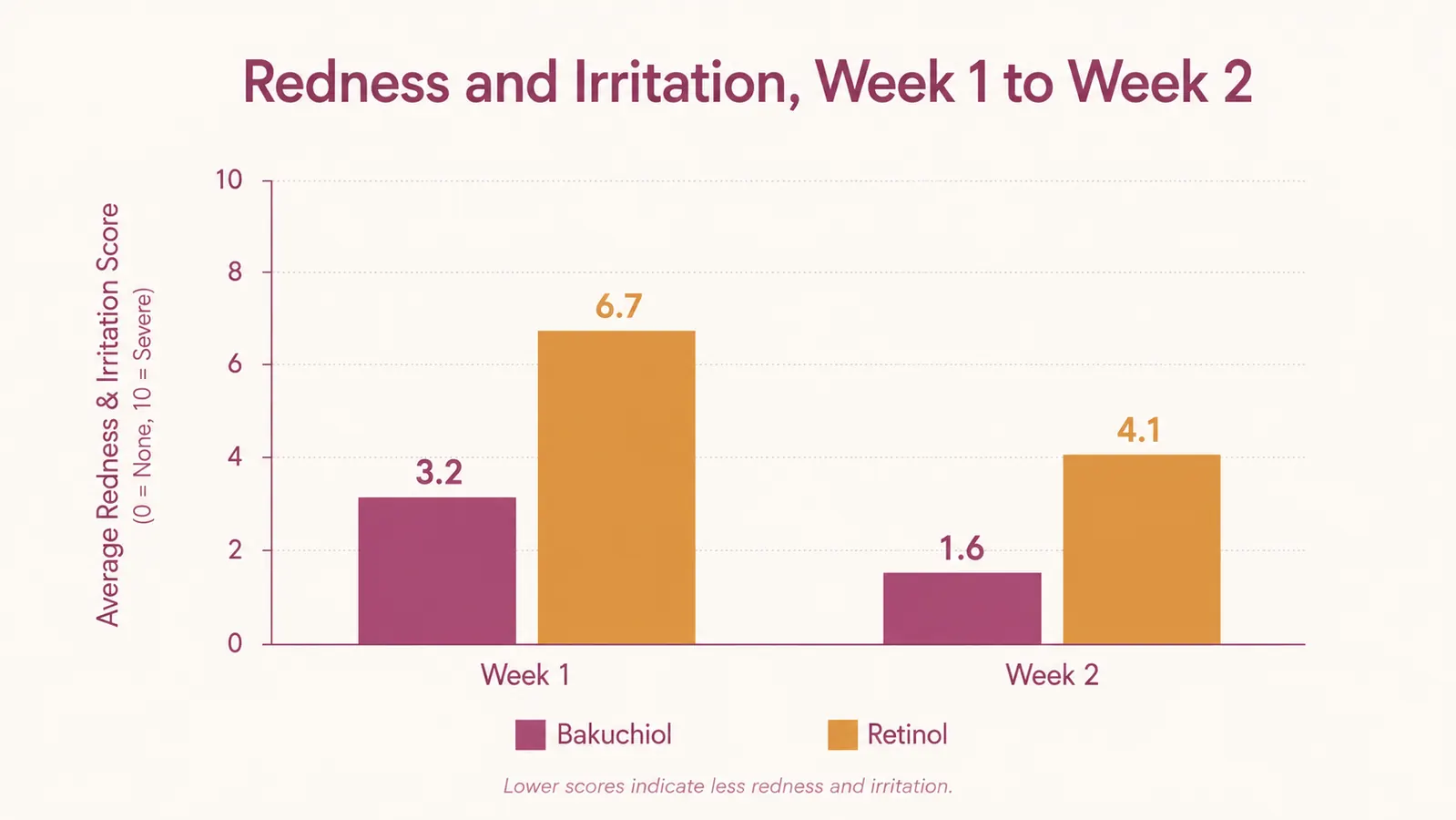
By day four of the retinol serum, my notebook already had the word flaky written twice, once for my chin and once along my nostril creases. By day four of the bakuchiol serum, the only note I had written was a small question mark next to slightly dry, which resolved on its own the next night after I added an extra swipe of moisturizer on top. That gap between the two never really closed over the full eight weeks. Retinol calmed down eventually, as it usually does once your skin builds tolerance, but it took roughly three weeks to get there. Bakuchiol never needed that adjustment period at all.
Where CELDYQUE Bakuchiol Wins
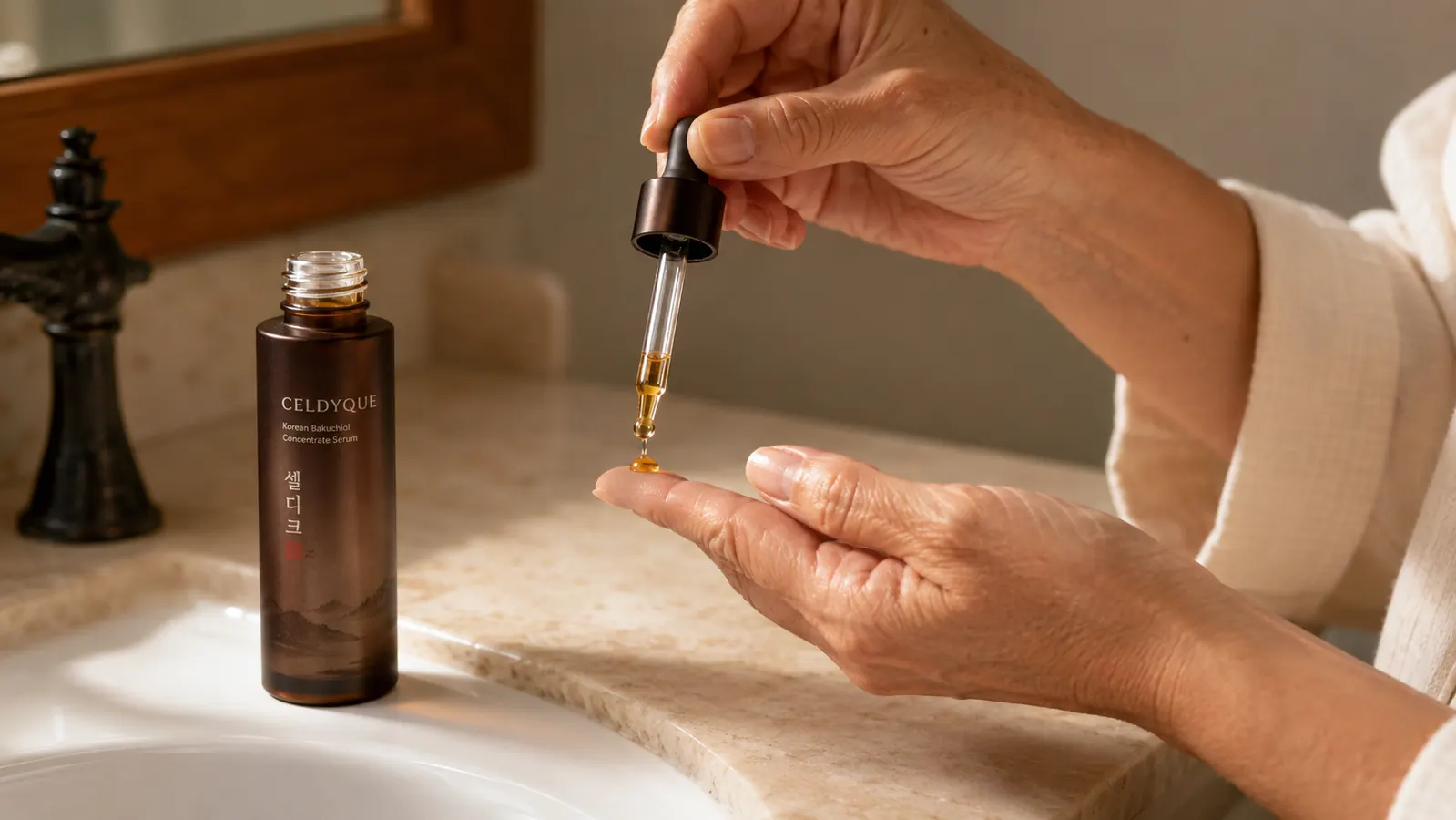
The single biggest difference I noticed, and the reason I am writing this comparison at all, is that I never had to work up to using CELDYQUE the way I did with retinol. With my old prescription tube, I had to start at twice a week, wrapped in about four different buffering creams, and I still ended up flaking around my nose and mouth by day ten. With the CELDYQUE bakuchiol concentrate, I applied it every single night starting on night one and never once had that tight, sunburned feeling. My skin, which reacts to almost everything I try, from new laundry detergent to certain sunscreens, simply did not stage a protest. That alone made it easier to actually finish the bottle instead of letting it join the graveyard of half-used serums in my bathroom drawer.
The second win is daytime flexibility. Retinol famously breaks down in sunlight and can make your skin more sun-sensitive, so it has to be a nighttime-only product, tucked carefully under sunscreen the next morning with extra vigilance. Bakuchiol does not carry that same warning. I ended up using a thin layer under my moisturizer most mornings on days I forgot my nighttime routine, which is not something I would ever have risked with retinol. For a retired grandmother who is out gardening or walking the dog most mornings, not having to think twice about sun exposure was a genuine relief.
It also plays nicer with the rest of my routine. I still use my squalane oil most nights, and layering the bakuchiol serum underneath it never once caused pilling or extra irritation. When I tried the same layering trick with the retinol serum, my skin got noticeably more reactive within days, forcing me to strip my routine down to almost nothing just to calm things back down. Bakuchiol simply asked less of me, which after 45 years of trial and error with skincare, matters more than any ingredient label ever will.
There is also the concentrate factor worth mentioning. CELDYQUE comes formulated at a high 30,000 ppm strength meant to be mixed into your own moisturizer or serum drop by drop, which let me control the intensity myself on nights when my skin felt more reactive than usual, say after a long day in the sun or a stressful week. Retinol serums rarely give you that same flexibility. You either use the fixed percentage on the label or you skip it entirely, and there is no in-between dial to turn down.
Where Retinol Wins
I want to be fair here, because retinol earned its reputation honestly. In the second and third weeks, once my skin had adjusted, the retinol serum did show slightly more visible change around my deeper nasolabial lines than the bakuchiol had at the same point. Retinol has decades of peer-reviewed studies behind it, including prescription-strength formulas dermatologists prescribe for genuinely advanced sun damage. If you have resilient skin that has already been broken in with acids and actives for years, retinol may simply move faster because it works through a more aggressive mechanism at the cellular level.
Retinol also has a longer track record for very specific concerns, like stubborn adult acne or deep textural scarring, where the research is simply more established. Bakuchiol is catching up fast, with newer head-to-head studies showing comparable results over longer stretches of use, but if your dermatologist is treating a specific diagnosed condition rather than general aging and dullness, retinol may still be the tool they reach for first. I am not a doctor, and if you have a prescription-strength concern, that conversation belongs with your own physician, not with a woman writing from her kitchen table in Ohio.
There is also the simple fact that retinol has been around long enough that most dermatologists know exactly how to pair it with other treatments, from chemical peels to laser work, in a way that has been studied and refined for years. Bakuchiol is still a newer name in that conversation. It is catching up quickly in the research, but if you are the kind of person who wants decades of data behind every ingredient you put on your face, retinol will always have the deeper paper trail.
Skip the two-week peel and go straight to glow
If your skin has ever rebelled against retinol the way mine did, CELDYQUE Bakuchiol Concentrate Serum gives you the same firming, smoothing goal without asking your face to suffer through it first.
Amazon Check Today's Price on Amazon →Bakuchiol never once made me look worse before it made me look better. Retinol always did.

The Ingredient Difference, in Plain English
Retinol is a synthetic form of vitamin A. Once it is on your skin, it works by speeding up cell turnover, which is exactly why it can smooth fine lines and even out texture so effectively, and exactly why it can also leave skin raw and flaking while your cells adjust to that faster pace. Bakuchiol comes from the seeds of the babchi plant, used for generations in traditional skincare, and modern research has found it binds to some of the same receptors in skin cells that retinol does, without triggering the same inflammatory response along the way. That is the plain-English version of why one of these tends to cause a purging period and the other, in my experience and in the newer studies I have read, mostly does not.
Neither ingredient is a miracle, and I want to be honest about that too. Both work slowly, over weeks and months, not overnight. What changes is how your skin feels while you wait for those results. I would rather use a gentler ingredient every single night for two months than a stronger one I keep abandoning halfway through the bottle because my face is angry with me. Consistency, more than raw ingredient strength, is what actually moved the needle on my own skin.
Who Should Buy Which
If you are over 45, have sensitive or rosacea-prone skin, are pregnant, breastfeeding, or simply cannot tolerate the redness and flaking that retinol so often causes, a bakuchiol serum is the more livable choice. It gives you real firming, smoothing, and glow benefits without turning your bathroom mirror into a source of dread every night. It is also the smarter starting point if you have never used an anti-aging active before and want to build a tolerance gently rather than jumping straight into something aggressive.
If, on the other hand, your skin has spent years already adjusted to strong actives, and you are working with a dermatologist on a specific, diagnosed concern like deep acne scarring or significant sun damage, retinol still has a stronger research base and may move faster for that particular problem. For everyone else, especially the women I talk to most, the ones who just want their skin to look rested and even without a nightly battle, bakuchiol is the one that actually stays on the bathroom shelf instead of getting shoved to the back of a drawer.
And if you are somewhere in the middle, someone who tolerated retinol fine years ago but finds your skin thinner and more reactive now than it used to be, that is worth paying attention to. Skin changes as we age, and what your face handled at 35 is not always what it handles at 55 or 65. Switching to something gentler is not giving up on results. It is simply matching the product to the skin you actually have today, not the skin you remember having.
My own answer, after eight weeks of testing both side by side on the same face, was simple. I finished the entire bottle of CELDYQUE. The retinol serum is still sitting in that drawer, half used, exactly where the last one ended up.
Give your skin the gentler option first
You can always go stronger later. Start where your skin can actually tolerate consistency, night after night, without the redness setting you back.
Amazon See CELDYQUE Bakuchiol Serum on Amazon →